Bibliography¶
TeXSmith reads bibliographic data from BibTeX files and from YAML front matter. Use it to keep citations and references tidy in academic writing, technical docs, or any project that wants repeatable citation management.
Using Bibliography Files¶
Pass one or more .bib files on the command line:
texsmith docs/chapter.md references.bib
You can also add file1.bib file2.bib as positional inputs alongside a MkDocs site so every page sees the same pool of references.
Using the front matter¶
You can declare bibliography entries directly in the YAML front matter of your Markdown documents:
press:
  sources:
    bibliography:
      # Extract citation from DOI
      citation-keyword: https://doi.org/10.1000/xyz123
      # Manual bibliography entry
      AI2027:
        type: misc
        title: AI 2027
        date: 2025-04-03
        url: https://ai-2027.com/ai-2027.pdf
        authors:
          - Daniel Kokotajlo
          - Scott Alexander
          - Thomas Larsen
          - first: Eli
            last: Lifland
          - Romeo Dean
A top-level bibliography: key is the deprecated spelling; tmark lint --fix
moves it under press.sources.
The format mirrors BibTeX, translated to YAML by pybtex.
Two approaches:
- Provide a DOI link; TeXSmith resolves it into a full BibTeX entry.
- Provide a manual entry with the fields you need.
See the academic paper example or the book example.
Citation Syntax¶
A citation is the @ sigil against the bibliography registry — the same sigil
that refers to a figure or a section, because the registry decides what the key
means.
---
press:
  sources:
    bibliography:
      WADHWANI20111713: https://doi.org/10.3168/jds.2010-3952
---

# Introduction

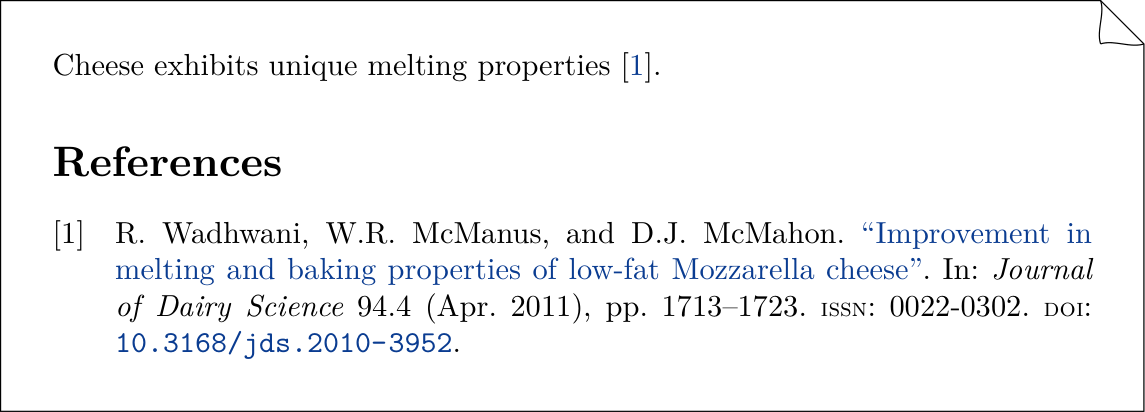
Cheese exhibits unique melting properties @WADHWANI20111713.
Which renders into:
A bare @key is the short, parenthetical citation by default and
@[key, locator] the same short form with a locator attached:
As shown by @[WADHWANI20111713, p. 33], and elsewhere
@[see WADHWANI20111713, pp. 33-35; AI2027, ch. 1]. Suppress the author with
@[-WADHWANI20111713], and cite several at once with @[AI2027; WADHWANI20111713].
Locators follow Pandoc: a recognised locator word (p., pp., ch., sec.,
§…) followed by a range, or free suffix text. Pandoc's own [@key, locator]
is accepted for import and never emitted.
Setting press.features: {citations.narrative: true} in the front matter
switches every bare @key of the document to the narrative form instead
(\textcite in LaTeX, #cite(<key>, form: "prose") in Typst — "Einstein [3]"
rather than "[3]"). Either form stays reachable per citation regardless of the
document's default: @[+key] forces the narrative form inside brackets,
@[-key] forces the year alone.
A DOI can be cited in place through the predeclared doi prefix, without a
front-matter entry: @doi:10.3168/jds.2010-3952. The same DOI cited twice is
one entry. @https://doi.org/… is accepted as sugar and normalised.
Resolution order for any @key is: declared counter prefix (doi and gls
included), then the bibliography. A key present in two registries is a hard
warning, and an unresolved key renders visibly as [?key].
The footnote spelling is deprecated
TeXSmith 0.6 spelled citations [^key] and ^[k1,k2]. Both are still
parsed with a deprecation warning, and while they last the
footnote-versus-citation shadowing rule is preserved: a real footnote with
the same key wins. Once they are retired, ^[…] becomes an inline
footnote. tmark lint --fix rewrites them; see
Migrating to TMark.
BibTeX¶
BibTeX is an old, loosely specified format with many dialects (bibtex, bibtex8, pbibtex, and more). The most complete parser is biber, but it is Perl-based and not embeddable. TeXSmith relies on pybtex, which covers the common cases.