Captions
Markdown doesn’t ship with a native caption primitive for figures or tables. The closest thing is image alt text:

Alt text exists for accessibility, not for captions. Some browsers show it as a tooltip, but it is not a real caption and you can’t style it separately. Moreover, since it is inserted in an HTML tag's attribute, it can’t contain block elements or complex formatting.
TMark's answer is the caption line: a paragraph of its own, adjacent to the
float, spelled Kind: text {#id}.
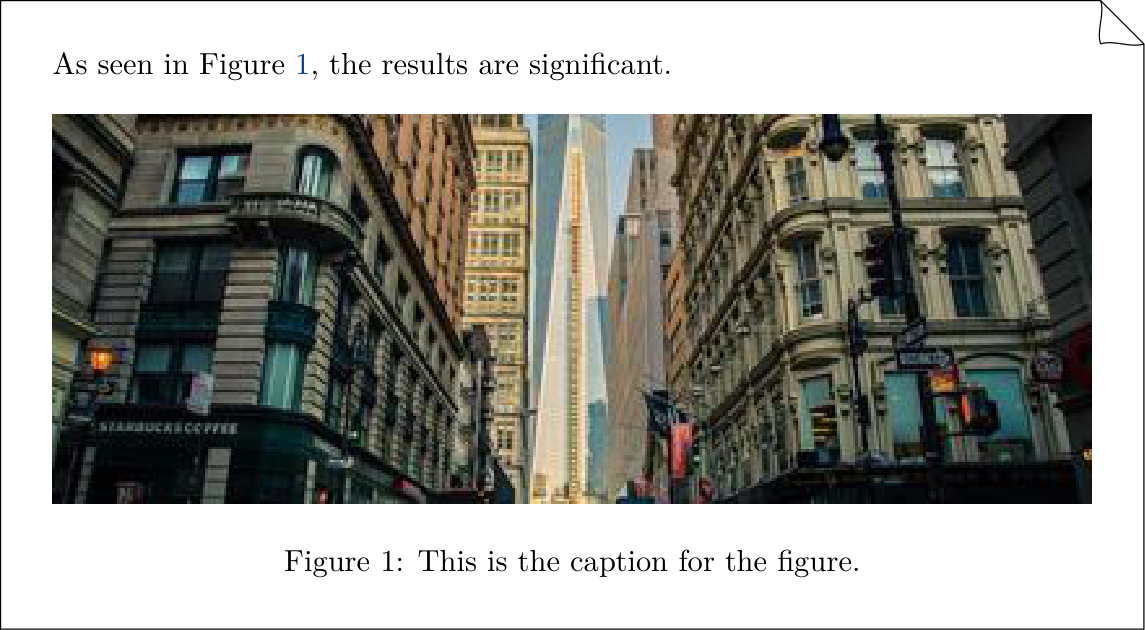
As seen in @fig:results, the results are significant.

Figure: This is the caption for the figure. {#fig:results}
The kinds are Figure:, Table: and Listing:. The attribute list is
optional and is a full one ({#fig:plot .wide}); its #id is the float's
anchor. Prefixed ids (fig:, tbl:, lst:) are the recommended convention
and are what @ references read best.
The PyMdownX caption block is deprecated
/// caption and /// figure-caption with an indented attrs: line are
still parsed, with a deprecation warning, until tmark fmt has had time to
rewrite the corpus (see Migrating to TMark). Their
id could not contain a colon — pymdown-extensions rejected fig:results
and the block silently degraded to plain text — which is exactly the trap a
canonical spelling must not have. tmark lint --fix converts them.
Enable numbering and each document gets its own sequence starting at 1.
LaTeX
LaTeX wraps figures/tables in figure/table environments, uses \caption{} for the text, and \label{} for cross-references:
As seen in Figure \ref{fig:results}, the results are significant.

\begin{figure}[htbp]
  \centering
  \includegraphics{image.png}
  \caption{This is the caption for the figure.}
  \label{fig:results}
\end{figure}
Addressing issues
- Consistent numbering across a document
- Easy cross-references
- Short captions for lists of figures/tables
Coherent numbering
Markdown headings aren’t numbered, so figures/tables can’t piggyback on heading numbering. On the web that’s fine—hyperlinks rule the navigation story—but in print numbering is essential. Guideline:
Printed documents shall have numbered heading elements, figures, and tables for cross-referencing. Web documents, however, should not have numbered headings, figures, or tables, relying instead on hyperlinks for navigation.
Printed LaTeX floats figures and tables, so writers can’t assume a caption stays “above” or “below” the reference. HTML is literal: the figure stays where you put it.
On printed documents, the words "above" and "below" when referring to figures and tables shall never be used, as their position may vary due to floating. On web documents, "above" and "below" may be used, as figures and tables appear exactly where they are defined.
tmark lint flags a position word next to a reference (position-word) for
exactly this reason.
Cross-referencing captions
That rule complicates cross-references: web versions prefer “this figure below,” whereas LaTeX wants “Figure 2.” A textual reference lets you write the prose and keeps the number out of the body:
As seen in [this figure](#fig:results), the results are significant.

As seen [here](#fig:results), the results are significant.

The results [shown](#fig:results) are significant.
On the web the text is the link and nothing is added. In paged media a hyperlink is not enough, so the template appends a locator whose shape is declared per medium:
press:
  refs:
    textual:
      print: "{text} ({number})"   # "this figure (3)", or "{text} (p. {page})"
      web: "{text}"
When you want the number in the prose, refer with the @ sigil and let the
counter render the label word:
As seen in @fig:results, the results are significant.
Language is handled by the counter registry, not by you: “Figure” in English,
“figure” (lowercase) mid-sentence in French, “Abbildung” in German.
@Fig:results capitalises the label word at the start of a sentence.
In LaTeX the caption id is emitted verbatim as the \label:
As seen in Figure \ref{fig:results}, the results are significant.
The empty-link form [](#fig:results) is the class-C fallback for pure-Markdown
toolchains and resolves to the same reference.
Short caption names
Printed lists of figures appreciate a condensed caption. LaTeX handles this via the optional \caption[] argument:
\caption[Short caption for list of figures]{This is the caption for the figure.}
TMark reuses the Markdown alt text as that short entry, and the caption line
carries the long one:

Figure: This is the caption for the figure, with **Markdown**. {#fig:results}
Caption lines in detail
| Header 1 | Header 2 |
|----------|----------|
| Cell 1   | Cell 2   |

Table: This is the caption for the table. {#tbl:sample}
```python
def bubble_sort(items): ...
```

Listing: Bubble sort, naive version. {#lst:bubble}
A Listing: line makes the code block a numbered listing whose caption is the
block's header and whose id is its label, in LaTeX as in Typst.
The canonical source position is after the block; where the caption is
printed (above a table, below a figure) is the template's business. A
Table: line placed before the table is accepted for Pandoc compatibility, and
the printer never emits it.
The attachment rule is one rule for every kind: a caption line attaches to the
block before it when that block is a float that has no caption yet, otherwise
to the float after it. Inside a figure container a caption with no such
neighbour is the caption of the figure itself. A caption line with no float
next to it stays a plain paragraph and raises caption-no-host.
Subfigures
A figure container groups images; each becomes a subfigure, and the
caption is a Figure: line like everywhere else:
::: figure {cols=2}
{#fig:boot}
{#fig:crash}
Figure: Watchdog traces before and after the fix. {#fig:traces}
:::
This renders “Figure 1” with “(a)”, “(b)”; @fig:crash yields “figure 1b”.
A sub-figure takes no number of its own
The container advances the fig counter once, and each image resolves
to that number suffixed with a letter in document order, lower case (1a,
1b, …, wrapping after z). A page with a plain figure and a
figure of two labelled images therefore numbers 1, then 2 with 2a and
2b — not 1, 2, 3, 4 — so a figure count over a whole book or site advances
once per container rather than once per image.
The rest follows from the same rule:
| The container holds | What happens |
|---|---|
| only paragraphs of images | the images are sub-figures, lettered |
| a single image | that image is the figure: one number, no letter |
| a table, prose or a listing | a plain float; an image in it numbers like any other |
| no anchor and no caption | nothing is numbered, sub-figures included |